
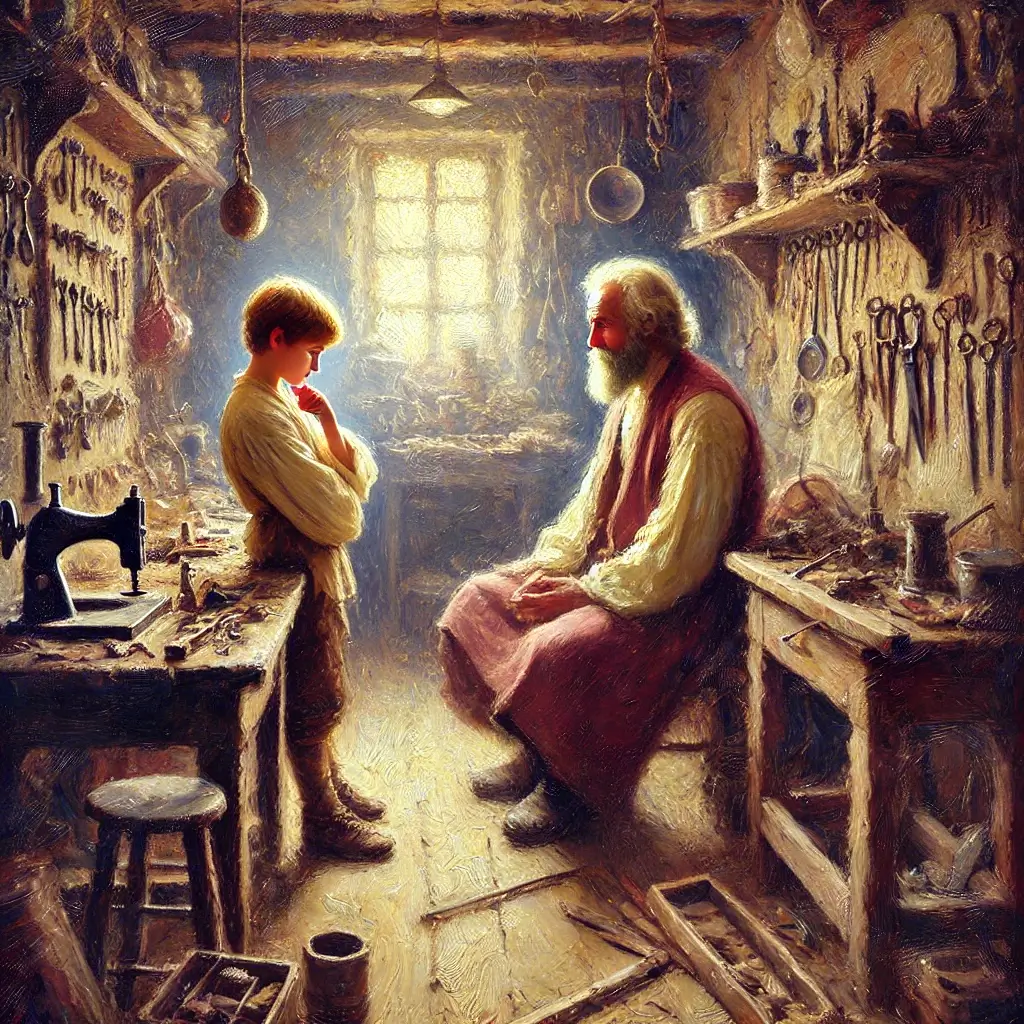
How many times has this phrase echoed in my thoughts, planting the belief that Existence, Life, the Universe, the Transcendent, whatever we choose to call it, was fallible, incompetent, lacking the Wisdom I thought I possessed.
If only…
- “…fire didn’t burn human flesh, no one would suffer burns”
- “…viruses and bacteria didn’t exist, diseases wouldn’t torment us”
- “…aging weren’t part of the process, we would stay young forever“
- “…time could freeze during happy moments, we would never know nostalgia”
- “…scars didn’t leave marks, we could forget more easily”
- “…gravity were gentler, there would be no painful falls“
- “…people could stay forever, we would never have to say goodbye”
The list could go on forever, couldn’t it?
Do I really know how Life should be? Do I believe I can correct the Universe, forgetting that behind every pain, there’s something I can’t grasp, perhaps a hidden wisdom?
I fool myself into thinking I have the right answers, that I can rewrite the rules as I please, as if the Universe were a clumsy apprentice and I its Master.
The phrase “if only” becomes an excuse, an illusory refuge, a mantra that reassures me but ultimately imprisons me, a way to contain a pain I can’t always bear when things don’t go my way.

Life and Judgment
When pain overwhelms me, when injustice creeps in lingering doubt, I ask myself if Life was truly designed with Love or if it’s just a chaotic entanglement of random events. Anger explodes, my heart rebels, and turmoil gives birth to judgment: I want a different world, a world that meets my needs and desires.
I cling desperately to that “if only,” as if it could rewrite the fabric of Existence while I vent my frustration towards everything that doesn’t align with my expectations.

Beyond “If Only”
“If only” is a captivating illusion, an excuse that keeps me from truly living.
It is my rebellion against a destiny that (I believe) ignores me. It’s easy to fantasize about how things should be; it’s much harder to accept them for what they are. Every time we seek refuge in “if only,” we lose a fragment of real life. We deprive ourselves of the chance to be surprised, to find beauty and meaning, even in life’s toughest challenges.
Some people have stopped saying “if only.” They have learned to let go, to stop chasing an unattainable ideal, to embrace reality with all its shadows and lights.
And me? Do I have the courage to follow their example? Or will I keep holding on to my personal war against what I cannot change?

Opening Up to Life
Opening up isn’t about giving up; it’s about having the courage to face the unknown, even through fear.
Being curious is itself a way of being open, a way to transcend our limits without losing our essence. It is a subtle art, this balancing act of rising beyond while staying grounded, of growing without forgetting who we are.
It means living without knowing everything, without having all the answers…Life isn’t linear or predictable, but it’s full of possibilities.
It’s curious, this role reversal we play: tiny observers of an infinite cosmos, we take it upon ourselves to critique Existence. After learning how to hold a brush, we presume to teach Michelangelo (the Clumsy Apprentice, according to us) how to paint the Sistine Chapel.
Do we not see the irony in our attempt to correct a system of which we barely understand the surface mechanics?
And yet, within this presumption lies a certain sweetness: it’s like the child who, in their first explorations of the world, believes they can grasp the moon with their hands.
It’s a naivety born from our deep need to make sense of what surrounds us, to feel like participants and not just passive spectators of the grand Spectacle of Life.
When we see those we love suffer, when fate strikes us with what seems like senseless cruelty, “if only” becomes our refuge, our desperate attempt to imagine a more comprehensible, fair, and manageable Universe. It’s easier to think of the Universe as a clumsy apprentice rather than accepting that some of its laws completely escape our understanding.
And herein lies a fascinating paradox: this “presumptuous” desire to understand and correct the Universe has led to humanity’s greatest achievements. Science itself is born from this tension, from this urge to “put our hands” into the mechanisms of Nature. But there’s a subtle difference: the true scientist, like the true artist, knows they are, first and foremost, an eternal apprentice.
They do not claim to correct the Universe but seek to understand it in order to flow harmoniously with its laws. It is the curious humility of the Explorer, not the arrogance of the Ultimate Human Judge.
Perhaps the real difference lies here: between those who say “if only” with the presumption of knowing how the Universe should be, and those who ask “how can I live better with others in the meantime?” with the wonder of those who know they still have everything to learn.

Celebration
To celebrate means to stop fighting against ourselves, to welcome every part of us with kindness. Without denying difficulties, they are part of our story, like pages in a messy yet precious book.
Maybe life isn’t what we imagined, but it is ours, and we are part of it. We can choose to dwell on regrets, or we can choose to live, with all the intensity and beauty (and pain) it brings. With its unanswered questions, its sudden surprises, its unexpected lessons.
After all, if only I didn’t say “if only.” 🙂
And you?
Greetings from a true clumsy apprentice…


